
Moving to  .
.
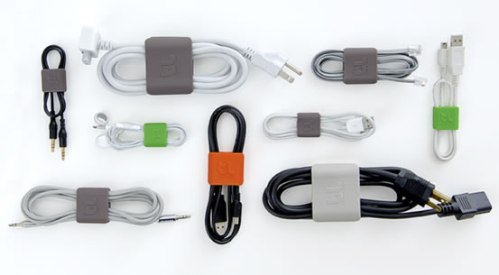
Bluelounge CableBox Mini

 —–
—–
Bluelounge CableClip
 —-
—-
Bluelounge CableDrop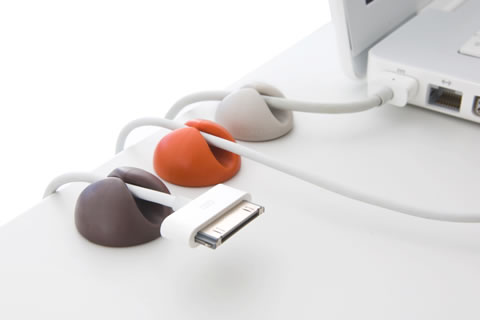 —-
—-
Lufdesign Leaf Ties

The Arrival:
I picked the the Dell Inspiron 17 after my college graduation. Intel i5 Core processor, let’s see what you can do! [I forgot to write down the actual model #, but oh well.]
The notebook was delivered in a huge cardboard box. Despite its starting weight of 6.8 lbs, it felt surprisingly light for its dimensions. Perhaps it was only a tad heavier than my 15″. The shell was sleek, but easy to smudge. There were ports galore.

Display:
With so much LCD real estate, it was a breeze cascading and accessing multiple windows. The experience of scrolling through websites, however, was similar to that of a smaller display (the screen height seemed unchanged).
The LCD was very bright. The lowest setting was fine, except when in direct sunlight. The biggest downside: I couldn’t escape the persistent glare from the glossy screen.

Operating System:
Windows 7 is a darling, with the crisp aesthetics of Vista and the familiarity of XP.
Mobility:
The notebook did not fit in any of my backpacks/bags. The solution was to have it ride shotgun in my car en route to the cafe. A 17″ notebook is not recommended for travelers—it’s bulky and wants to lounge around at home.
Keyboard | Audio:
The keypad felt like an add-on to fill up all the space below the display. The numeric keypad offset the keyboard & touchpad, which shifted my typing posture. Is this ergonomic? My head & eyes would naturally center on the display, but my hands were at an awkward left-ward slant.

The speakers were on the bottom of the laptop, so the audio was always muffled. The default equalizer settings were unusual; voices sounded garbled even at high volume . The left cooling fan activated sporadically and would drown out the sound from the left side of the laptop, worsening the sound quality.
I would ditch the keypad in favor of a centered keyboard with [big!] speakers by its side. I own a USB keypad and I rarely use it.
Multitasking:
Scrolling through hundreds of image & text-laden posts was absolutely seamless. No skips or misses. Same with long PDFs on Adobe Acrobat Reader. I streamed music and barreled through YouTube videos & movie trailers. I blogged and read the news. I watched seasons of Mad Men and revisited Breaking Bad, sometimes on fullscreen or minimized next to a web browser. I edited multiple files on Photoshop.
I tried all of the above, all at once. Hm. I could keep a million tabs and applications open because they never lagged. Even when I let my friend run an unnamed engineering/modeling program in the background, the performance did not suffer. That’s awesome. It must be the Intel i5 Core processor at work.
Final thoughts:
I went back to my laptop and netbook and they seemed…slow [why aren’t you fast as an i5!?]…and the LCDs…minute. Maybe it’s time for an upgrade.
—-
FTC Disclaimer: I was sent an Intel i5 Core notebook to test drive for a week, as part of the Intel Youth Review Program.
- New data from a Web site suggests that not only do many people plan similar dates, but like lemmings, they also collectively migrate from one theme to the next.
- Young women have been copying Lady Gaga’s wider-than-life eyes, but the contact lenses are contraband, and doctors are concerned.
- The crucial breakthrough to completing [Christopher Nolan’s] “Inception” script was considering what could happen if multiple people could share the same dream.“Once you remove the privacy,” Mr. Nolan said, “you’ve created an infinite number of alternative universes in which people can meaningfully interact, with validity, with weight, with dramatic consequences.”
- A recent study found that more patients die of medical mistakes in the month of July than any other month.
- The health care industry has a garbage problem.
- After years of effort to coax empathy from machines, robots and devices designed to soothe, support and keep us company are venturing out of the laboratory.
- The psychological devices people use to manage what they express can affect social interactions in unintended ways.
- Soaring labor costs caused by worker shortages and unrest, a strengthening Chinese currency that makes exports more expensive, and inflation and rising housing costs are all threatening to sharply increase the cost of making devices like notebook computers, digital cameras and smartphones.
- Slurp digital eyedropper sucks up, injects information wirelessly.
Ten years after President Bill Clinton announced that the first draft of the human genome was complete, medicine has yet to see any large part of the promised benefits.
For biologists, the genome has yielded one insightful surprise after another. But the primary goal of the $3 billion Human Genome Project — to ferret out the genetic roots of common diseases like cancer and Alzheimer’s and then generate treatments — remains largely elusive. Indeed, after 10 years of effort, geneticists are almost back to square one in knowing where to look for the roots of common disease.
A Decade Later, Genetic Map Yields Few New Cures [via NYTimes]
—–
A decade ago, drug companies spent billions of dollars equipping themselves to harness the newly revealed secrets of human biology. Investors bid the stocks of tiny genomics companies to stratospheric heights.
That “genome bubble” has long since popped. And not only has there been no pharmacopeia, but some experts say the Human Genome Project might have at least temporarily bogged down the drug industry with information overload.
As the head of Novartis’s pharmaceutical business lamented in 2000, “Data, data everywhere, and not a drug, I think.”
Awaiting the Genome Payoff [via NYTimes]
In another serious setback in the effort to stem the flow of oil gushing from a well a mile beneath the Gulf of Mexico, BP engineers said Saturday that the “top kill” technique had failed and, after consultation with government officials, they had decided to move on to another strategy. [via NY Times]

Related headlines [May 30, 2010]:
- BP’s top kill effort fails to plug Gulf oil leak
- Oil spill vessels would scatter if tropical storm approaches
- Obama takes responsibility for coping with spill
- Documents Show Early Worries About Safety of Rig
- Ever Rising Political Stakes for Obama
- Gulf Coast Fishermen Fear Disruption of Their Way of Life
- Our Fix-It Faith and the Oil Spill
- How Do Oil Dispersants Work?
—-
An infographic map visualing the worst oil spills in history:

“Crude Awakening,” a detailed infographic on the Gulf oil spill catastrophe.

MIT graduate student Robert Wang and Associate Professor Jovan Popović developed a gesture-based computing system with cheap hardware: an ordinary webcam and a pair of $1 multicolored Lycra gloves.

Other low-cost prototypes, i.e. the wearable SixthSense, have used tape on the fingertips. Wang said those were limited to “2D information” where “you don’t even know which fingertip [the tape] is corresponding to.”
Wang and Popović’s system can translate the 3D configuration of your hands & fingers on-screen with almost no lag time. (Screencap from the proof of concept video shown below).

Their software compares glove webcam images against a reference database of gestures. When a match is found, the software renders the corresponding hand position in a fraction of a second.
Hand-tracking is made possible by the distinctive glove design. The patchwork arrangement is unique to the front and back of the glove; the colors are distinguishable from each other and from background objects–under a range of lighting conditions.
Possible applications are in video games or in engineering. For example, designers could use this system to manipulate 3D models of commercial products or civic structures.
Wang is expanding his idea and plans to design similarly patterned shirts for use in whole-body motion capture.
—–
Those gloves are pretty rad on their own…is it bad that I want a pair to wear and not compute with? A shirt would be fantastic.
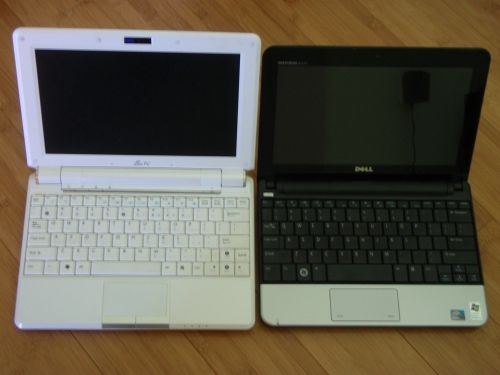
This alpine white Dell Mini 10 was a present from Intel.
I’m using my awesome Asus Eee PC 1000HA as a benchmark. Yes, I’ve cut out an Apple-shaped logo out of black duct tape and stuck it on for kicks.

First impressions of the Dell Mini 10:
- Oh, the default appearance settings for Windows XP are ugly. Let’s fix that ASAP.
- This Dell Dock, a custom ObjectDock for organizing shortcuts, is cool.
- The 1.33Ghz Atom Z520 processor feels sluggish (my Asus has the 1.60Ghz N270).
- Bonus points for the sleek clamshell design.
- It has the same ports, with the exception of the HDMI in place of VGA.

Other observations:
- The netbook has a smaller screen angle. My Asus can flatten out like a book.
- The ElanTech Smartpad is great. Shortcuts can be enabled for two and three finger taps, swipes, and pinches. The “cover gesture” is my favorite–plant your hand over the trackpad to minimize all open windows. The left and right bottom corners of the trackpad are clickable.
- The keyboard seems nearly full-size. But it’s not as snappy.
- The Dell Mini 10 is noticeably lighter and feels more compact.
—-
Unfortunately, I love my all-white ASUS because it has more battery life. So I am passing the Dell Mini 10 off to my little brother. I’m going to need to buy an HDMI to VGA adapter…hm.
In late February, a group of tech-savvy bloggers and social media enthusiasts dropped by Intel headquarters to learn more about the world’s leading computer chip maker.
Last year, Intel launched an global ad campaign to highlight the company’s forward-thinking, technophile culture. The campaign, taglined “Sponsors of Tomorrow,” humorously highlights the major achievements of Intel’s engineers. This is one of the TV commercials:
In the spirit of the ad campaign, the company hosted an immersive event to expose “youth rock stars” to their latest breakthroughs and unique corporate culture (the commercials don’t lie).
At the start of the summit, participants faintly associated Intel with computer chips. After a whirlwind tour of Intel, a maze-like complex with odd splashes of color, participants revised their opinions. The connection was clear: Intel = innovation.
Demos of Intel’s R&D projects included forays into clever home-management devices, online services, and mind-boggling video analysis software.
Attendees discovered that Intel works from the “inside,” upgrading data transfer and computer processing power by leaps and bounds, to enable the development of tomorrow’s business and consumer electronics. Intel sets the standard for future markets today.
 Left to right: a USB stick, an 80-core processor, and a typical Intel elevator
——
Facts:
- Intel’s has hypnotic, glowing, color-changing walls.
- 80% of Intel’s processors are for more powerful computers.
- An emerging market for netbooks are 6-11 years old, who are fighting to use the laptop/desktop at home.
- Intel is committed to Moore’s Law, which suggests that computing speed doubles roughly every 1.5 years.
——
Cool stuffs from Intel:
1. Light Peak, originally USB 4.0, is a high-speed optical cable capable of moving 10 Gb/s–with the potential to scale up to 100 Gb/s. With Light Peak, a single port type could connect peripherals, displays, drives, and more. The cable will be flexible and light (cutting down on wire jungles); and laptops can be made thinner (the VGA port is a fatty). The modules below can transfer 20 Gb/s (each wire is 10 Gb/s), so you could download a Blu-Ray movie in seconds.

2. The fully featured, 13.4″ Dell Adamo XPS is a jawdropper.
3. The Home Energy Management System monitors your appliances, reminds you to avoid peak hours (and water your plants), notifies you of needed repairs, and shows how you can use electricity more wisely. It connects to the Internet and has all sorts of live widgets. Also, it doubles as a clock.

4. I can’t remember what this was called, but it’s an algorithm that can look at real-time video feeds and identify specific parameters. In the pictures below, it’s detecting pedestrians and surrounding motor traffic in a moving vehicle. You need an 8-core processor for this.
 The program could also deliver sports highlights (game-winning goals, failed plays, etc) or follow a particular player. With facial recognition software tacked on, you could gather the most epic or tragic scenes in your favorite television drama.
—–
FTC disclaimer: Intel provided all participants (that’s me) with a free Dell Mini 10 netbook and full accomodations at the Santa Clara Marriott.

The Skiff, the largest eBook reader on the market, debuted at this year’s Consumer Electronics Show. The device is optimized for newspaper and magazine content and boasts an 11.5-inch touchscreen with 1600×1200 resolution and 3G+WiFi connectivity. Price TBA.
—-

LG has developed a 19″ flexible electronic-paper screen that “only requires power when the screen is refreshed.” I wonder what the battery life will be?
 The Present Future

You must be logged in to post a comment.